


Wishbone Wooden Bike Safety: Stopping, Supervision and Practice Areas
Wishbone wooden bike safety is not established by three wheels or a reassuring photograph. The historical Original handbook gives separate warnings about assembly, protective equipment, stopping and location. Reading those categories together is more useful than treating the vehicle as a toy that can be left anywhere with a child.
Wooden bike safety includes adult responsibilities
Printed page 17 of the Original handbook with 2009 copyright requires adult assembly because the product contains small parts. It also requires adult supervision during use. These are distinct responsibilities: correctly preparing the vehicle does not remove the need to supervise the rider afterwards.
The same warning section limits use to one rider. Do not infer that a broad rear stance makes room for a second child or turns an old trike into a passenger vehicle. Its illustrated shape and a seller's description are not a substitute for the manufacturer's stated operating restrictions.
Plan for feet to stop the bike
The handbook says the child should be coached to use their feet for braking and stopping. It recommends protective equipment including closed shoes, an approved safety helmet and suitable protective clothing. This guide reports that historical manufacturer's advice; it does not make a claim that a particular helmet, shoe or lesson eliminates injury risk.
Fit and stopping should not be confused. The separate seat-adjustment page calls for flat-foot ground contact. Our seat-height guide explains that documented fit check, but being able to reach the ground is not evidence that a child has learned to stop. Keep instruction and supervision explicit rather than assuming either from an age recommendation.
Choose the area by its hazards
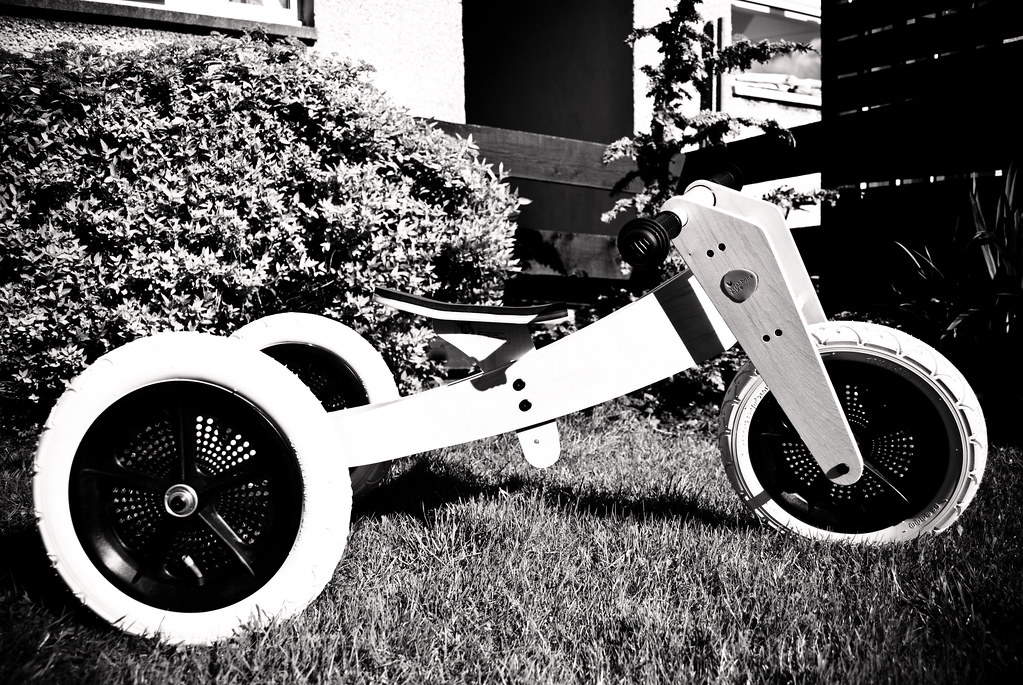
The historical warnings exclude public highways, places with motor vehicles and sloping areas. They also rule out use near steps, driveways, roadways, bodies of water and swimming pools. A green lawn in a photograph does not show all the surroundings or establish that the location meets those restrictions.
Check the actual practice setting before each session and resolve uncertainty before riding. The pictured bike is a relevant historical wooden three-wheel example, not a demonstration of a supervised lesson, protective equipment or approved terrain. Find the other narrowly scoped ownership references through Wishbone Bikes, while retaining the matched manufacturer's full warnings as the operative source.
Practice-session FAQ
Do three wheels remove the supervision requirement?
No. The historical warning still requires adult supervision during use.
Is grass automatically an approved riding location?
No. Check the actual hazards, slopes and surroundings against the manufacturer's restrictions.
Does this guide certify an old bike as safe?
No. Its actual condition, assembly and applicable instructions still require verification.