


Rocky Mountain 2018 Altitude Suspension Rise: It Is Not Progression
The 2018 Altitude suspension rise percentage and the shape called progression answer different questions. Reading them separately is more useful than assuming every increase in a chip's position number is one equal suspension step. For a covered Rocky Mountain, this is document interpretation first: the recall notice (https://www.cpsc.gov/Recalls/2018/Rocky-Mountain-Bicycles-Recall-Mountain-Bicycles-Due-to-Crash-Hazard) requires stop-use and authorized-dealer inspection and repair verification before riding or rider-loaded setup work.
Separate 2018 Altitude suspension rise from curve shape
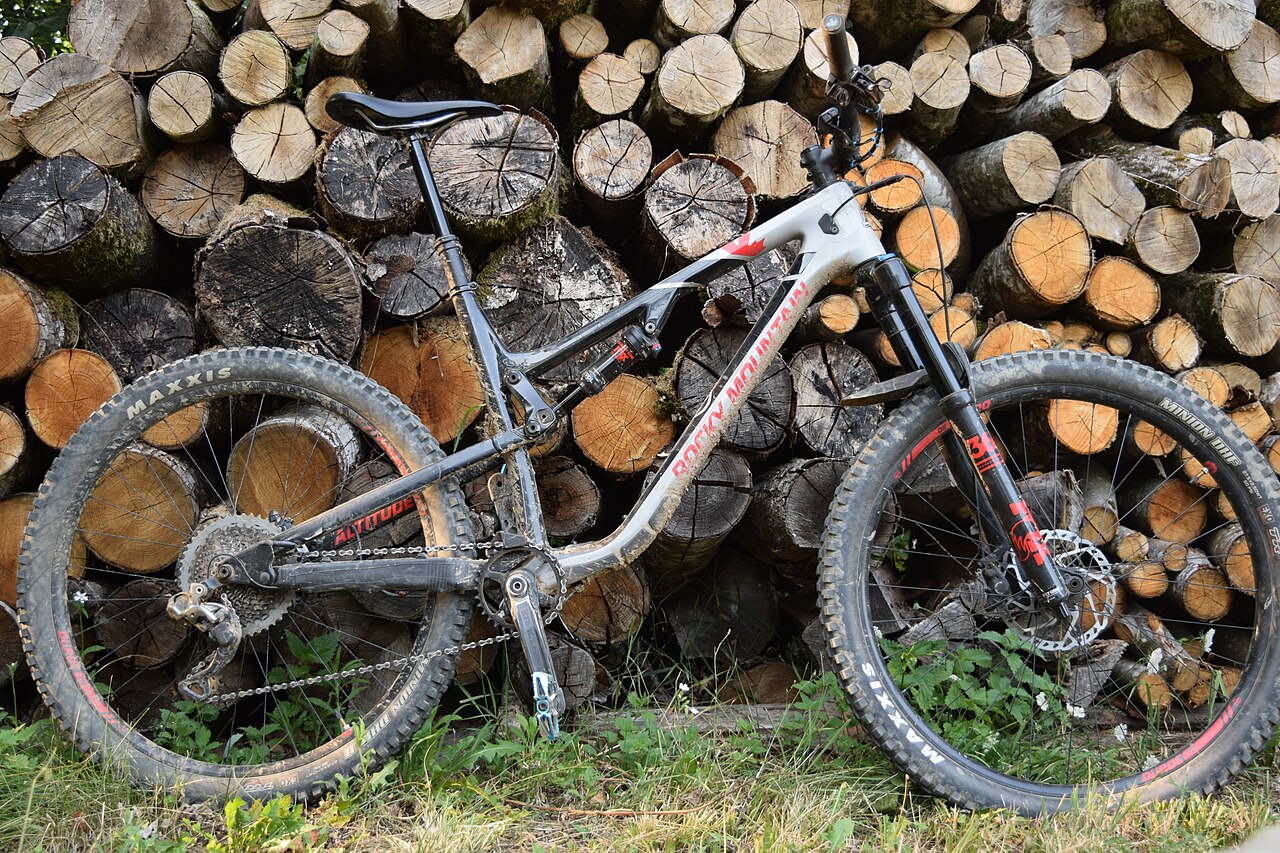
The manufacturer guide (https://resources.bikes.com/sites/default/files/resources/2018_Ride9_Altitude_EN.pdf) defines suspension rise as the difference between how hard it is to move the suspension at the beginning and at the end of travel. It measures that rise as a percentage. Its separate description of progression concerns how the rate of rise increases through the curve, rather than simply the total beginning-to-end difference.
On physical page two, the guide contrasts a more curved progressive line with a more linear rising-rate line. It explains that a more progressive curve moves more of the rise effect further into the travel. These are the manufacturer's descriptions of the suspension behaviour, not proof that a particular rider needs the largest percentage or the most curved diagram.
Read each configuration instead of interpolating
The position plates show why the nine numbers should not be treated as evenly spaced percentage adjustments. Position 1 lists 45.7 percent rise, while position 2 lists 47.2 percent. Position 3 lists 40.1 percent and position 5 lists 34.5 percent. The second number therefore has a higher listed rise than the first, despite the general slack-to-steep ordering.
Each plate also presents a geometry table and an illustration of the chips. A comparison should identify that whole configuration, not a percentage detached from its position. The guide's summary curve chart compares the slack, neutral and steep settings, while the individual plates supply the detailed percentage associated with each configuration.
When preparing a suspension enquiry, say whether the question concerns geometry, beginning-to-end rate change or how that change develops through travel. Those distinctions prevent a conversation about a harsh initial feel from being reduced to a single large or small percentage. The guide itself describes possible tradeoffs rather than promising an ideal outcome for every rider.
Do not convert these curves into an unsupported shock recommendation. The document does not establish coil compatibility, a replacement damper's tune or a pressure prescription for a given weight. A graph of the frame system is not a clearance test for a different shock body. Keep those component questions for an appropriately identified parts enquiry.
FAQ: Reading the diagrams
Is position 2 lower in rise percentage than position 1?
No. The guide lists 47.2 percent for position 2 and 45.7 percent for position 1.
Is a progressive curve the same thing as a rise percentage?
No. Percentage describes the beginning-to-end difference; progression describes how the rate of rise develops through the travel.
Can the chart alone select a replacement shock?
No. It describes the frame's suspension characteristics, not every replacement shock's mounting, clearance or tune.
Return to the geometry-first setup sequence to organise an enquiry. The Rocky Mountain topic distinguishes this historical platform from other generations.
Photograph credits and permissions
Photograph 1
Original title: Rocky Mountain Altitude C50 2018.jpg
Creator: ThienToons; creator URI: https://commons.wikimedia.org/wiki/user:ThienToons
Original source URI: https://commons.wikimedia.org/wiki/File:Rocky_Mountain_Altitude_C50_2018.jpg
License / permission: CC BY-SA 4.0
License / permission URI: https://creativecommons.org/licenses/by-sa/4.0/
Modification notice: Wikimedia-provided 1280×853 reduced-size version; no additional local changes.