


Wishbone Original Frame Flip: Plan the Change Separately from Seat Adjustment
The Wishbone Original frame flip is a structural reorientation described in the wooden bike's historical handbook. It is not another name for sliding the seat higher. An owner planning the change needs to establish that the instructions match the bike, understand which assemblies are disturbed and then assess the rider's fit again after correct reassembly.
Original frame flip: locate the actual instructions
The Original English manual puts this operation on printed pages 14–15, followed by seat adjustment on page 16. It carries a 2009 copyright and a Mark II ownership certificate. That edition information is useful when discussing an older wooden example, but it does not identify every bike that resembles the photograph.
Wishbone's NZ Original product description also presents a flipped-frame growth configuration. The contemporary listing confirms the design concept; it should not replace a version-matched assembly document or supply missing information about an early bike's fittings.
Understand the scope before loosening anything
The historical sequence involves removing the seat and front wheel, releasing the headset fastener and threaded rod, reorienting the frame and reassembling. That overview explains why this is more involved than a seat-only adjustment. Use the manufacturer's complete diagrams for the actual sequence rather than reconstructing it from a brief article.
Keep all removed components identifiable and stop if the bike differs from the manual. In particular, the source does not provide a universal bolt torque for this job. Similar appearance is not a reason to choose a torque from an unrelated bicycle, substitute a fastener or assume that a later replacement frame fits.
Recheck the rider rather than using a birthday trigger
Printed page 16 then calls for flat-foot ground contact when adjusting the seat. The decision therefore needs an assessment of the particular rider and correctly configured bike; this guide does not invent an age at which every child should move to the other orientation. See Original sizing and ground contact for that separate fit task.
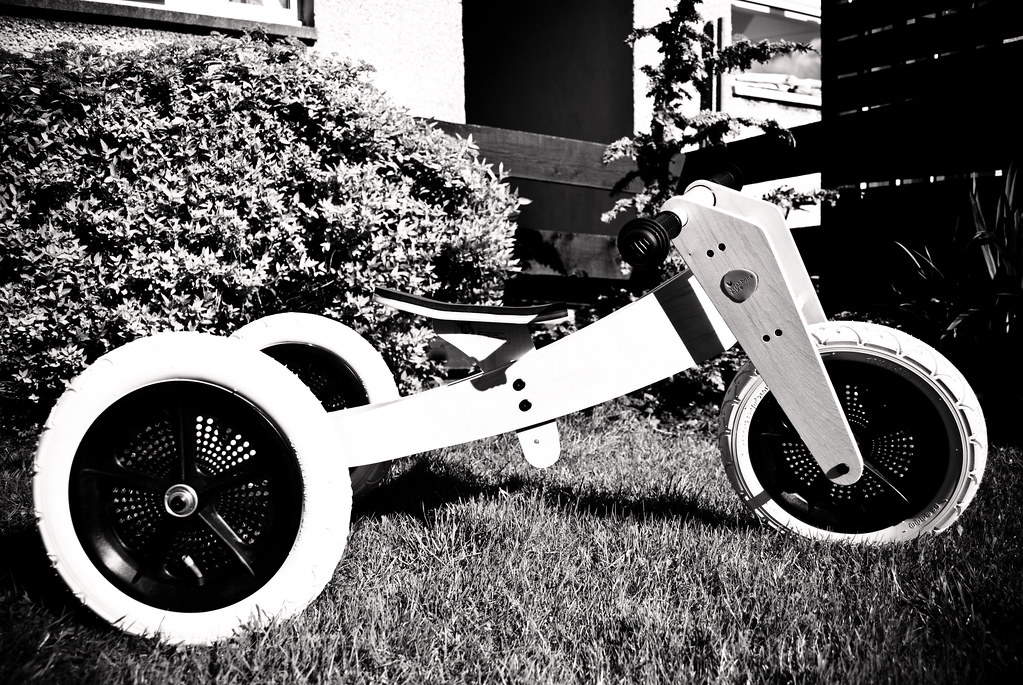
The photograph below records an actual wooden three-wheel Wishbone, not a before-and-after demonstration. Neither its capture date nor its visible stance proves a manufacturing year or a verified high-mode setup. Other historical owner references are collected in our Wishbone section.
Frame-orientation FAQ
Is flipping the frame just a saddle-height change?
No. The manual documents reorientation and subsequent seat adjustment as different operations.
Does the historical picture prove the required orientation?
No. Determine the configuration and fit from the actual bike and its instructions.
Can I use these pages for any Wishbone product?
No. Confirm the wooden Original edition; other product families require their own documentation.