


Merida Silex 400 bottom bracket: read BB86, BB71 and crank length correctly
Merida Silex 400 bottom bracket information appears in more than one row of the archive. BB86 describes the listed frame standard, while Shimano Pressfit BB71 names the supplied bottom-bracket entry. The chainset and crank length are recorded elsewhere. Keeping those fields separate is the useful starting point for a replacement discussion.
Separate Merida Silex 400 bottom bracket fields
The selected archived Silex 400 specification identifies an aluminium SILEX LITE frame with a BB86 bottom-bracket standard. Its component list gives Shimano Pressfit BB71 for the bottom bracket and Shimano GRX600 for the 46–30-tooth chainwheel. Those entries describe different parts of the original assembly; one should not be treated as a complete substitute for the other.
When asking for a replacement, state whether the problem concerns the installed bearing assembly, the frame interface or a proposed crank. A noise description alone cannot identify which part is responsible. Record the markings on the actual bicycle and any known replacement history. An archived original component is a reference, not a diagnosis of the equipment now fitted.
Read crank length independently of chainring teeth
The archive lists 170 mm cranks for XS and S, 172.5 mm for M, and 175 mm for L and XL. Those lengths are separate from the 46–30 tooth counts. A seller who confirms the chainrings has not necessarily confirmed the crank length. Ask for the relevant marking rather than estimating arm length from a whole-bicycle image.
These size-specific factory entries are not a prescription for a rider. An individual fit decision and an interface-compatibility decision need their own assessment. Choosing another length does not automatically establish compatibility with the frame, bottom bracket, front shifting or other installed parts. Keep the desired change explicit so a mechanic can assess the complete proposal rather than merely locate something labelled GRX.
Take a complete assembly question to the workshop
Provide the confirmed frame identity, installed crank and bottom-bracket identifiers, the proposed replacement and your reason for changing it. Ask which exact components and instructions apply together. Do not assume that a matching shell label means every spindle, bearing assembly or crank can be combined. This reference does not supply removal tools, installation forces, torque settings or an adaptor recommendation.
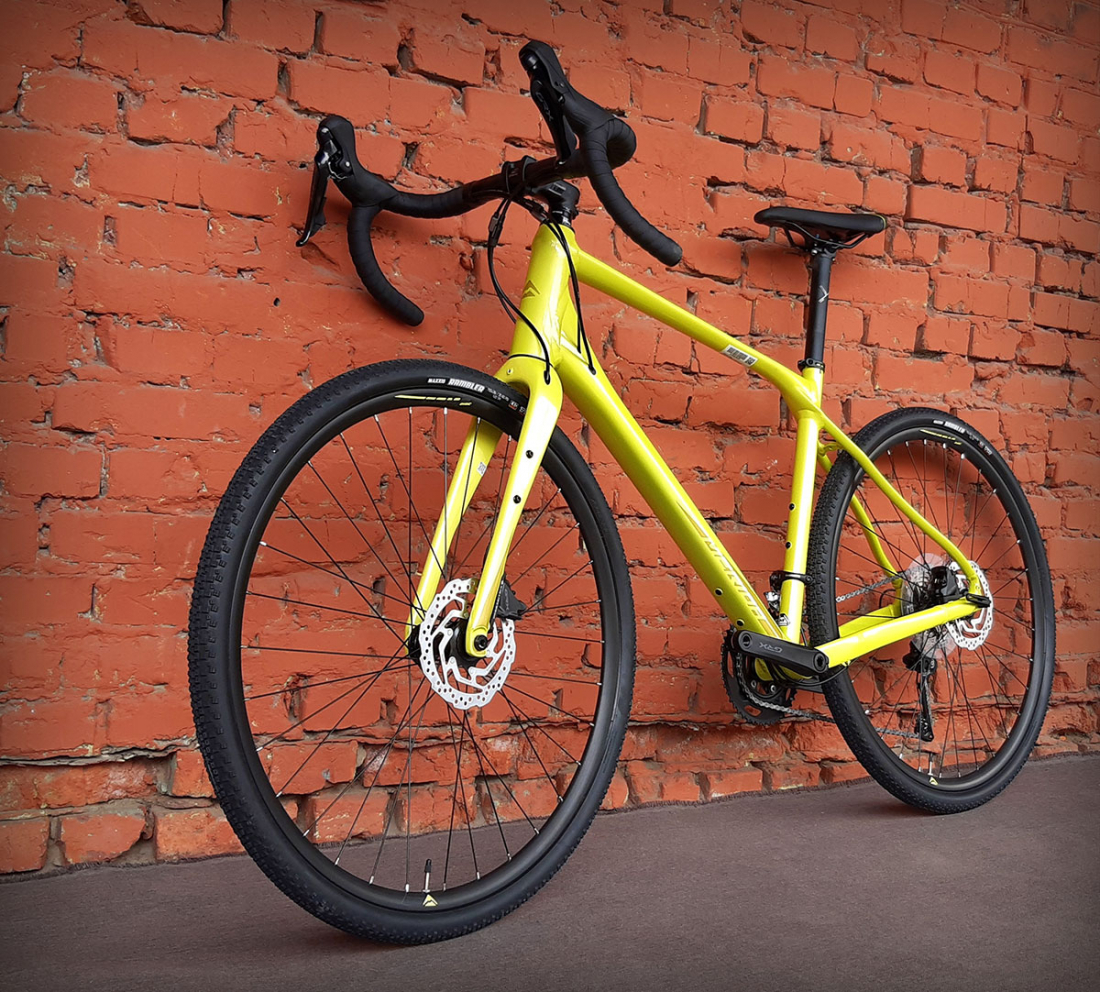
The yellow Silex 400 photograph was recorded in October 2021 and illustrates a historical model. It does not verify its hidden bearing assembly or establish that it matches the blue archived build. The practical endpoint is a written parts specification tied to the actual bicycle. Preserve that record with any work completed, so the next enquiry begins with an identified assembly rather than another guess from the model name.
FAQ
Do BB86 and BB71 identify the same catalogue field?
No. The archive uses BB86 for the frame standard and Shimano Pressfit BB71 for the component entry.
Does a 46–30 chainring set prove the crank length?
No. Read the crank's length marking; the archive lists different lengths by frame size.
Can the factory length decide which crank suits me?
No. Treat it as an original-build reference and assess personal fit and complete component compatibility separately.
Continue with the complete original-build identification guide or browse the Merida topic.
Sources: Merida archived Silex 400 specification.