


Ibis DV9 fork travel: separate V1 options from the geometry table
Ibis DV9 fork travel is not answered completely by choosing between the two numbers in the V1 specification. An owner comparing a replacement also needs to know which fork the geometry chart describes. Keep the supported travel options, the chart’s measurement condition and the fork actually installed on a used bicycle as three separate records.
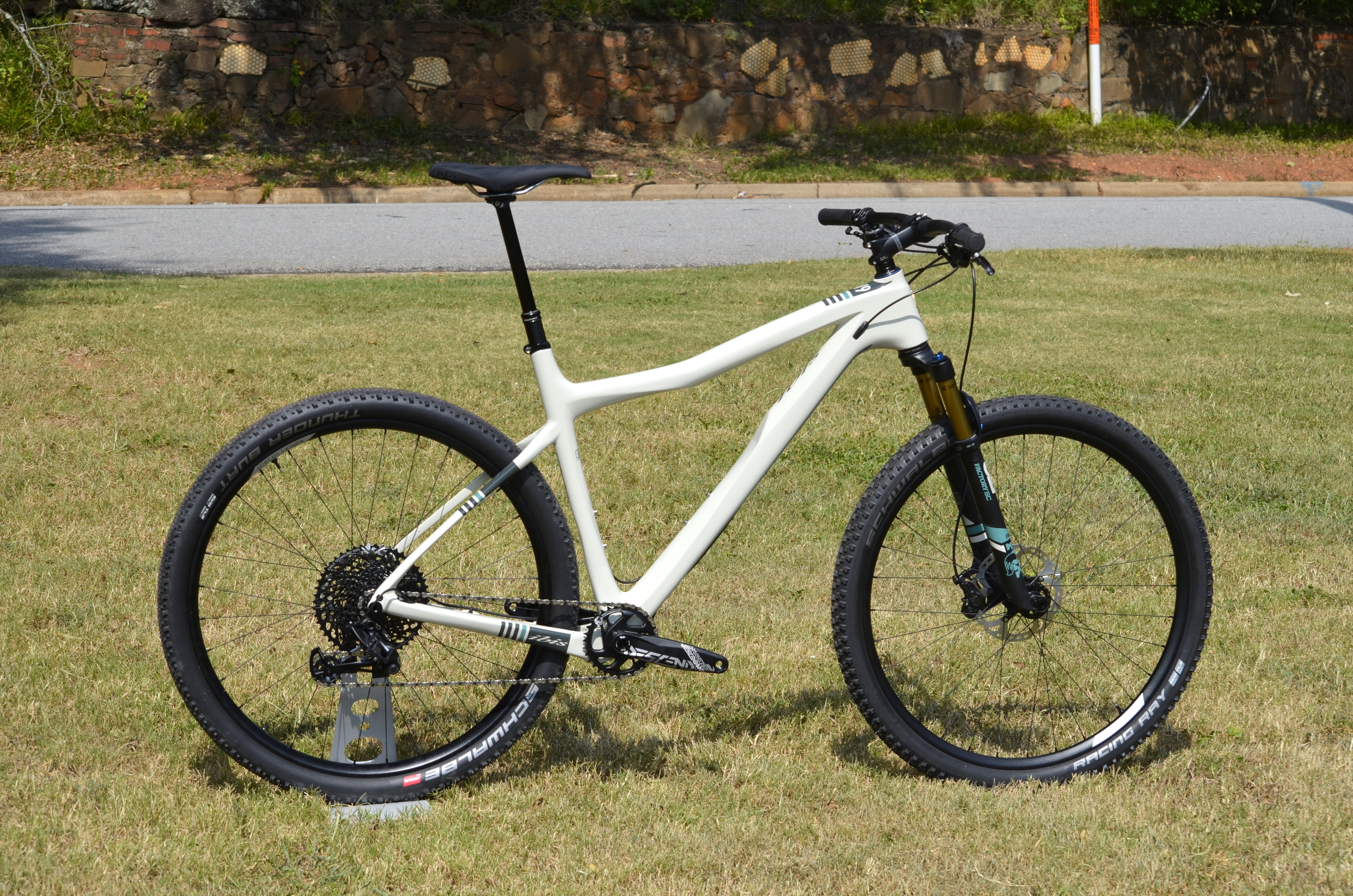
Ibis DV9 fork travel: identify the supported V1 fork options
The Ibis DV9 V1 archive (https://www.ibiscycles.com/bikes/past-models/dv9-v1) identifies the platform as 2018–2020. Its front-travel entry lists 100 mm or 120 mm and 51 mm offset. That is the historical specification to establish before comparing fork advertisements or applying a review of another DV9 generation to the frame in front of you.
Record the installed fork model and identifying markings, then obtain its actual configuration from the relevant component information. A suspension fork pictured on a DV9 does not prove its travel or offset. Nor does an owner’s description of the bicycle as a trail build replace confirmation of what is installed now.
Read the geometry heading before the numbers
The archive labels its geometry table “100MM FORK (503.7MM AXLE TO CROWN).” In that table the head angle is 68.5 degrees and bottom-bracket height is 300 mm across the four sizes. Those numbers belong to the stated 100 mm reference configuration. The page does not supply an equivalent 120 mm geometry table to quote alongside them.
Travel and axle-to-crown are different descriptions of a fork. Do not simply add 20 mm to a frame dimension, invent a new head angle or present a guessed reach figure as Ibis geometry. If the choice depends on those differences, ask for applicable technical information rather than treating a travel increase as a complete geometry calculation.
Compare the actual replacement specification
Give the shop the V1 frame identity, installed fork details and proposed replacement’s complete specifications. Include the requested travel, offset and relevant axle and steerer information. The archive’s 110 mm front axle-width entry helps identify the platform but does not settle every fork-interface detail. Check the assembly as a whole before purchasing.
If you are comparing two used DV9s, keep their frame sizes and fork configurations in separate columns. A number copied from the same archived chart does not prove both assembled bikes have that geometry. Check the wheel system independently with the DV9 V1 tire-format article, rather than using a fork change to justify another wheel diameter.
FAQ: Ibis DV9 fork travel
Does the V1 archive list a 120 mm fork option?
Yes. Its front-travel specification lists 100 mm and 120 mm, with 51 mm offset, while the displayed geometry table is specifically a 100 mm reference.
Can I quote the listed 68.5-degree angle for a 120 mm build?
The chart labels that value within its 100 mm configuration. Do not call it verified 120 mm geometry without an applicable source.
What does the 503.7 mm figure describe?
It is the axle-to-crown condition in the 100 mm geometry-table heading. It is not the fork travel or a published geometry calculation for a 120 mm replacement.
Use the Ibis overview and topic page to orient the model family. For a replacement, preserve the chart’s condition and confirm the proposed fork as an actual assembly.
Photograph credits and permissions
Photograph 1
Original title: Ibis DV9
Creator: Glory Cycles
Original source URI: https://commons.wikimedia.org/wiki/File:Ibis_DV9.jpg
License / permission: CC BY 2.0
License / permission URI: https://creativecommons.org/licenses/by/2.0/
Modification notice: Original JPEG unchanged.
Source disclaimer: Original Flickr photograph: https://www.flickr.com/photos/29558127@N06/48723117663/ Creator profile: https://www.flickr.com/photos/29558127@N06/ Embedded EXIF/IPTC/XMP creator tag: Picasa.