


CUBE Bike Classification: Match the Year Before Comparing Categories
CUBE bike classification needs a model-year reference. The manufacturer's support page separates the table used from model year 2025 onward from the one labelled through model years 2023–24. A category number quoted without that distinction can give an owner the wrong idea about permitted terrain, jumps or the effect of accessories.
Match CUBE bike classification to the dated table
In the manufacturer classification page (https://www.cube.eu/support/bike-classification), the newer category three includes rougher terrain and jumps or drops up to 60 cm. In the older table, category three excludes jumps, wheelies and lifting the rear wheel during braking. Those descriptions should not be treated as interchangeable simply because both headings carry the number three.
The change also affects comparisons above that level. The newer category four describes demanding descents below 40 km/h and jumps up to 120 cm, while the older category four describes occasional jumps or drops up to half a metre. These are source descriptions for their stated periods, not suggested riding targets or an invitation to choose the highest category that sounds appealing.
Identify the actual bicycle before planning the route
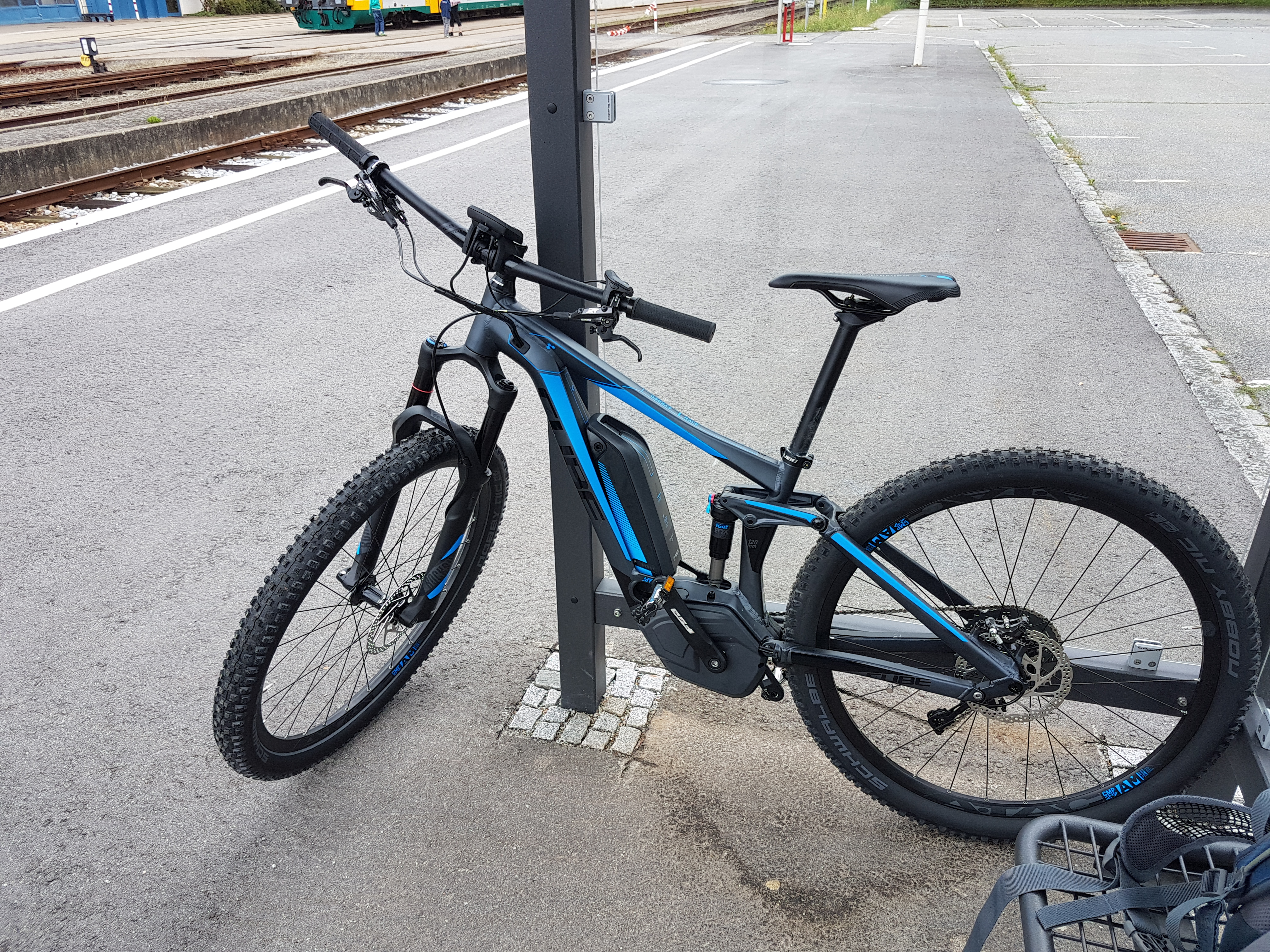
Find the classification assigned to the exact bicycle in its applicable manufacturer information, then read the relevant dated definition. A suspension fork, powerful motor or similar-looking frame does not assign a category. The historical Stereo Hybrid picture here provides brand context; it is not documentary proof of a category for that individual bicycle or its current parts.
The page also explains that using the specified accessory types, including kickstands, mudguards, luggage carriers and trailers, limits the relevant higher-category bicycle to category two. This is a use restriction after a permitted accessory is fitted. It does not establish that a particular stand, carrier or trailer mount has been approved for an otherwise excluded model.
For example, the older category two description covers paved and gravel roads and simple trails, with only brief loss of tyre contact caused by irregularities, and excludes jumps. An accessory-equipped bike should not continue to be described using a higher category's jump allowance just because its frame originally carried that higher classification. The mounted equipment changes the applicable use boundary.
A useful planning record therefore has four entries: model and year, assigned category, dated category definition and installed accessories. If one is missing, ask the dealer to clarify it before organising a riding trip around an assumed permission. A changed component or an unknown second-hand history is another reason to check the complete bicycle rather than relying on the strongest description found for the family name.
FAQ: Reading a category number
Is category three identical in both tables?
No. The current page's newer and older category-three descriptions have materially different jump restrictions.
Does category two make any carrier installation permissible?
No. A category limit and an accessory's mounting approval remain separate requirements.
Can suspension travel establish the category?
No. Use the exact model's assigned category and the definition for its period, rather than inferring permission from appearance.
The historical kickstand example shows why accessory approval still matters. The CUBE topic provides a place to keep these separate owner questions organised.
Photograph credits and permissions
Photograph 1
Original title: Cube Stereo Hybrid 120 HPA Race (2016).jpg
Creator: Fllweissbr; creator URI: http://commons.wikimedia.org/wiki/User:Fllweissbr
Original source URI: https://commons.wikimedia.org/wiki/File:Cube_Stereo_Hybrid_120_HPA_Race_(2016).jpg
License / permission: CC BY-SA 4.0
License / permission URI: https://creativecommons.org/licenses/by-sa/4.0/
Modification notice: Original JPEG unchanged.