


CUBE Bike Car Transport: Check the Contact Points and Battery First
CUBE bike car transport begins with where the carrier touches the bicycle, not just how many kilograms its label allows. CUBE distinguishes wheel and fork anchoring, frame clamping, aluminium and carbon construction. For a Hybrid, it also gives a separate battery instruction that should be resolved before the bicycle is left on an external car rack.
Choose CUBE bike car transport contacts deliberately
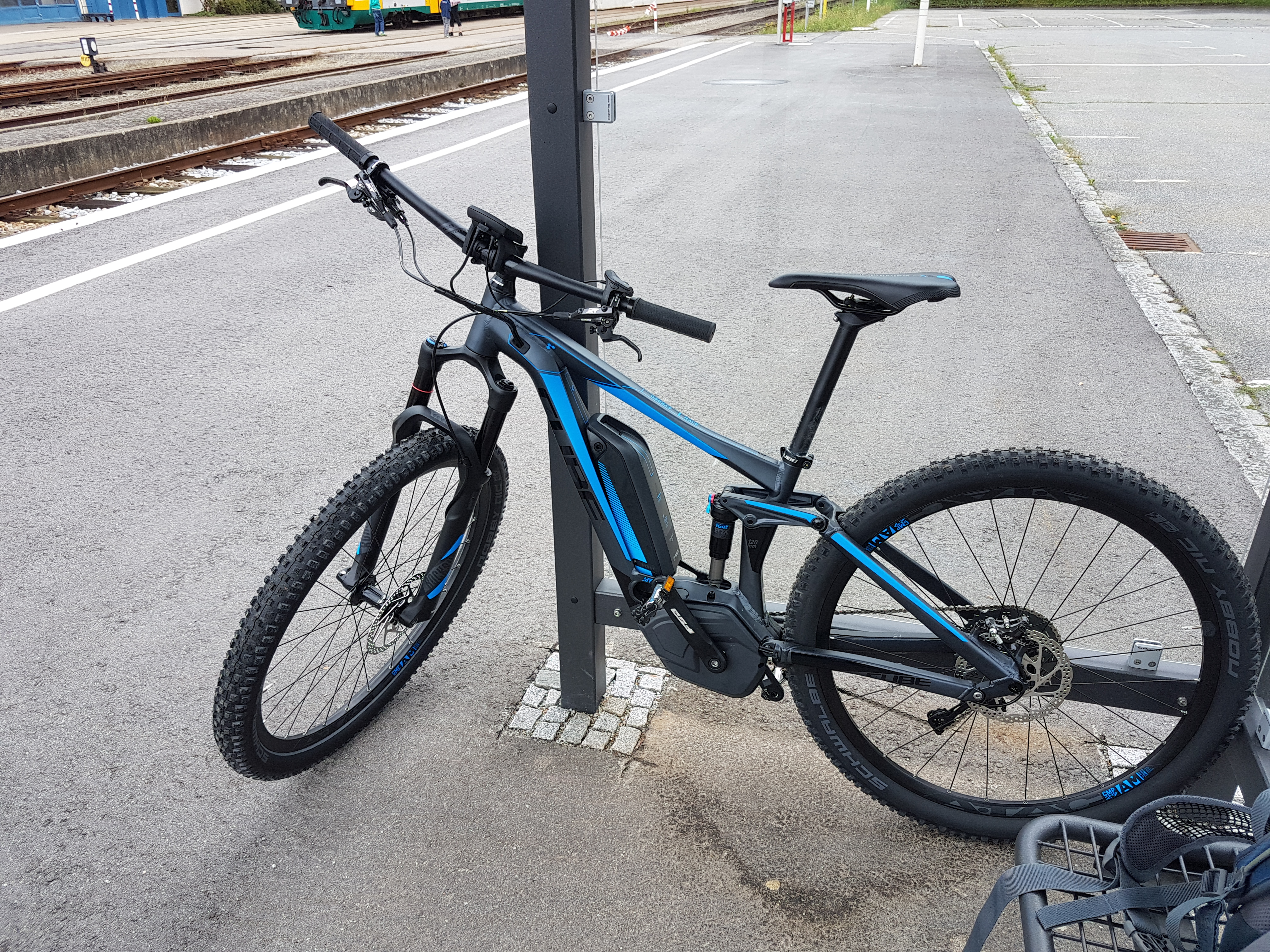
The manufacturer FAQ (https://www.cube.eu/support/help-faq) accepts roof carriers anchoring the rear wheel and front fork dropouts, but specifically excludes road bikes with carbon-fibre fork dropouts from that statement. It rejects roof-rack down-tube clamping because of crushing risk. A generic statement that a rack takes bicycles does not settle these frame and fork restrictions.
The FAQ describes rear-mounted carriers anchoring the wheels and top tube as generally suitable for aluminium-framed bicycles. That is a material-specific statement, not blanket permission to clamp a carbon top tube. Identify the actual frame construction and read the bicycle and carrier instructions together; the historical picture cannot certify a proposed rack contact point.
Keep carbon guidance and Hybrid battery handling separate
For applicable carbon bicycles, physical page nine of the CUBE MY25 carbon supplement (https://file.cube.eu/azwesc1xfg346/media/97/c9/55/1725348568/CARBON_MY25_EN.pdf?ts=1725348568) gives a stricter explicit warning against frame-tube clamping carriers. It also calls for protection from contact with other objects during transport. That carbon guidance is useful for an owner comparing transport systems, but it does not turn the photographed historical HPA model into a carbon frame.
The FAQ's Hybrid instruction is direct: store the battery securely in the car boot rather than leaving it attached to the bicycle on the external carrier. Plan that step before loading. Do not improvise a removal method for an unidentified battery system; have its correct operating instructions available and resolve a stuck or uncertain attachment before relying on the carrier arrangement.
Next check the actual load and the rack's own permitted capacities. A carrier weight rating cannot authorise an unsuitable clamp, and a permitted contact arrangement does not increase the carrier's rating. Account for every bicycle and accessory that will travel on it, using the carrier and vehicle instructions for the transport system instead of borrowing the bicycle's riding load rating.
Before departure, inspect whether protective covers, straps or neighbouring bicycles can rub the frame or its parts. The carbon supplement's stable, protected packing guidance is particularly relevant when the bicycle travels inside a car with luggage. CUBE's FAQ presents inside-car transport as the gentler alternative, but that still requires secure placement rather than a loose bicycle among unsecured objects.
FAQ: Preparing a car journey
Does an adequate rack weight rating approve any clamp?
No. The rack's load capacity and CUBE's restrictions on contact points are different checks.
Should a Hybrid battery stay attached outside the car?
No. CUBE's stated instruction is to store it securely in the boot, not attached to the externally carried bicycle.
Can aluminium rear-rack guidance be applied to carbon?
No. Keep the material-specific FAQ statement and the applicable carbon supplement's frame-clamping restriction separate.
The riding-load calculation addresses a different load question. Find the historical model background under CUBE bicycles.
Photograph credits and permissions
Photograph 1
Original title: Cube Stereo Hybrid 120 HPA Race (2016).jpg
Creator: Fllweissbr; creator URI: http://commons.wikimedia.org/wiki/User:Fllweissbr
Original source URI: https://commons.wikimedia.org/wiki/File:Cube_Stereo_Hybrid_120_HPA_Race_(2016).jpg
License / permission: CC BY-SA 4.0
License / permission URI: https://creativecommons.org/licenses/by-sa/4.0/
Modification notice: Original JPEG unchanged.