


Vintage Peugeot Bike Brakes: Read the Rim, Pad and Cable Together
Vintage Peugeot bike brakes should be read as a connected system: the lever moves a cable, the mechanism moves the pads, and the pads act on the wheel’s rim. The photographed Tourmalet 14 provides that context. Its recognizable brand and complete appearance do not establish the present condition of any braking component.
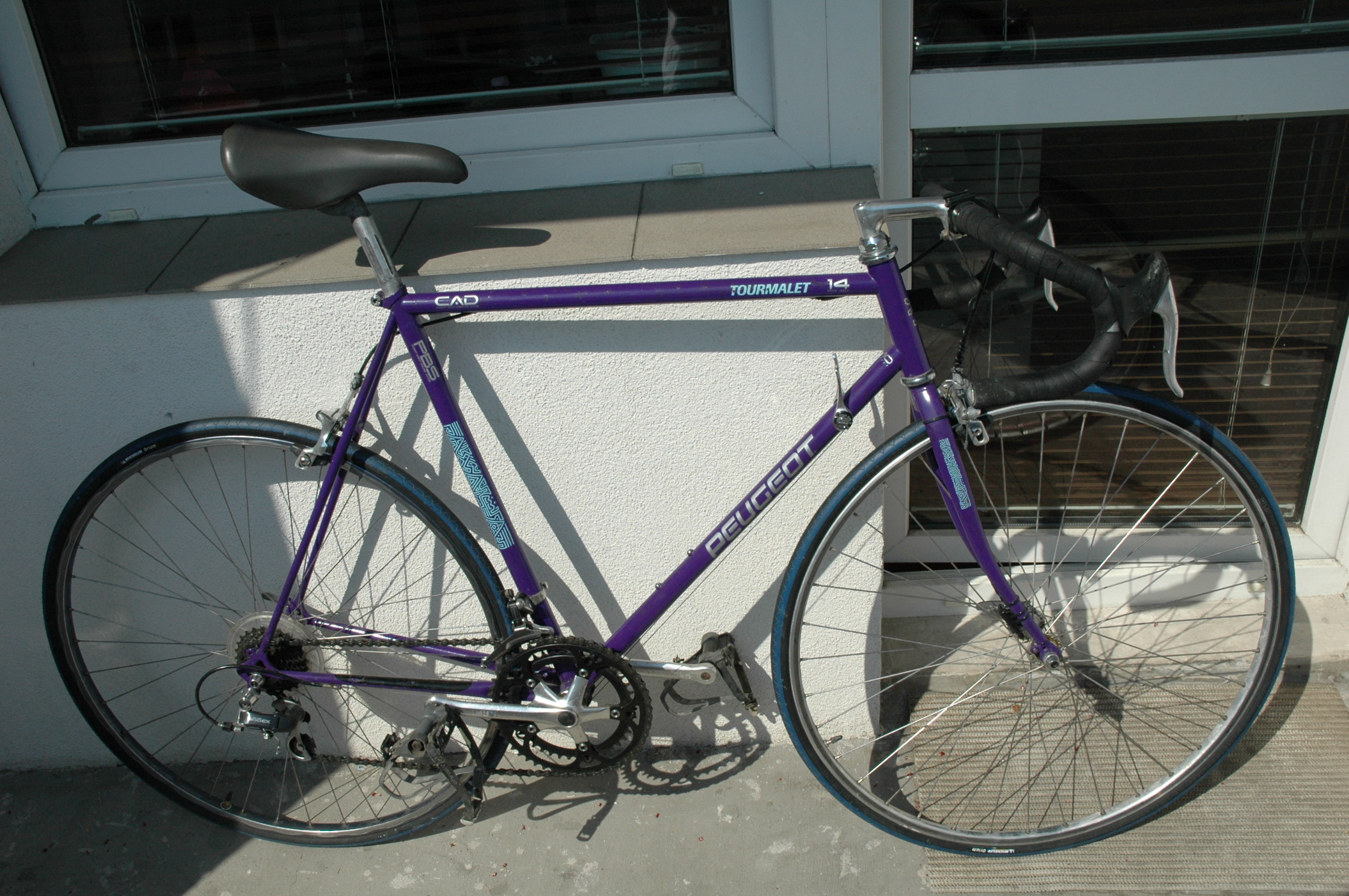
Vintage Peugeot Bike Brakes: What to Check Together
The brake section of Peugeot’s July 1974 manual (https://www.bikeboompeugeot.com/Owner%27s%20Manuals%20International/Peugeot%201974%20Owner%27s%20Manual/Peugeot%201974%20Owner%27s%20Manual%20Pg17.jpg) asks that the brake blocks contact the sides of the rim correctly. It also notes that control housing can settle with use, affecting adjustment. These are linked observations: changing cable adjustment is not a substitute for understanding where the pads meet the wheel.
The manual is a dated description of rim-brake equipment. It is not a specification sheet for every later Peugeot or every replacement brake. The Tourmalet photograph was taken in 2006; its production year and original component list have not been authenticated here. No braking performance has been measured for this guide.
Describe symptoms without deciding the repair
Before a service visit, record what concerns you: unequal pad movement, a lever position that has changed, a pad apparently meeting an unexpected surface, or a cable component whose identity is unclear. Explain when the behavior appears. A useful description gives the mechanic something to reproduce and inspect without presuming a single cause.
Read period adjustment advice in its own scope
The old page discusses adjustment points at the lever or brake mechanism. Which points exist, and how they should be used, depends on the actual installed parts. This article does not supply a universal tension, torque, pad compound or sequence of turns. It also gives no hydraulic bleeding procedure for these cable-operated examples.
If you are considering replacement pads or controls, obtain the markings and dimensions needed for that particular brake. Ask the person doing the work to confirm the relationship between the replacement, wheel and lever. A seller’s “fits vintage Peugeot” label leaves too much unresolved to establish suitability on its own.
Keep appearance and readiness separate
Polished parts and fresh-looking cable housings can be recorded as appearance; they are not a completed inspection. Have uncertain braking behavior assessed before riding. Use the Peugeot topic collection to investigate model identity and tires separately, and the Peugeot introduction for the broader bicycle background.
FAQ
Does this guide establish that the photographed brakes work safely?
No. The photograph is a historical illustration, not an inspection or braking test.
Does cable adjustment settle every pad-contact problem?
No. Identify the mechanism and examine the complete pad, rim and control relationship.
Can a period Peugeot manual identify a replacement pad?
Not by brand alone. The installed brake and wheel need a component-specific assessment.
Photograph credits and permissions
Photograph 1
Original title: Bicycle Peugeot tourmalet.jpg
Creator: Peter.shaman at Polish Wikipedia; creator URI: https://pl.wikipedia.org/wiki/Wikipedysta:Peter.shaman
Original source URI: https://commons.wikimedia.org/wiki/File:Bicycle_Peugeot_tourmalet.jpg
License / permission: CC BY-SA 3.0
License / permission URI: https://creativecommons.org/licenses/by-sa/3.0/
Modification notice: The original image file is unchanged by this publisher. No further earlier modification notice supplied.
Source disclaimer: No warranties are given. No endorsement is implied. Other rights may apply.