


Peugeot Folding Bike or Mini? Check the Joint Before Planning Storage
A Peugeot folding bike search can produce compact bicycles whose storage arrangements are unclear. Small wheels, a low main tube and tall adjustable-looking controls do not establish how a bicycle packs away. Start with the frame joint and a model-matched description, then ask for evidence of the actual machine’s operation.
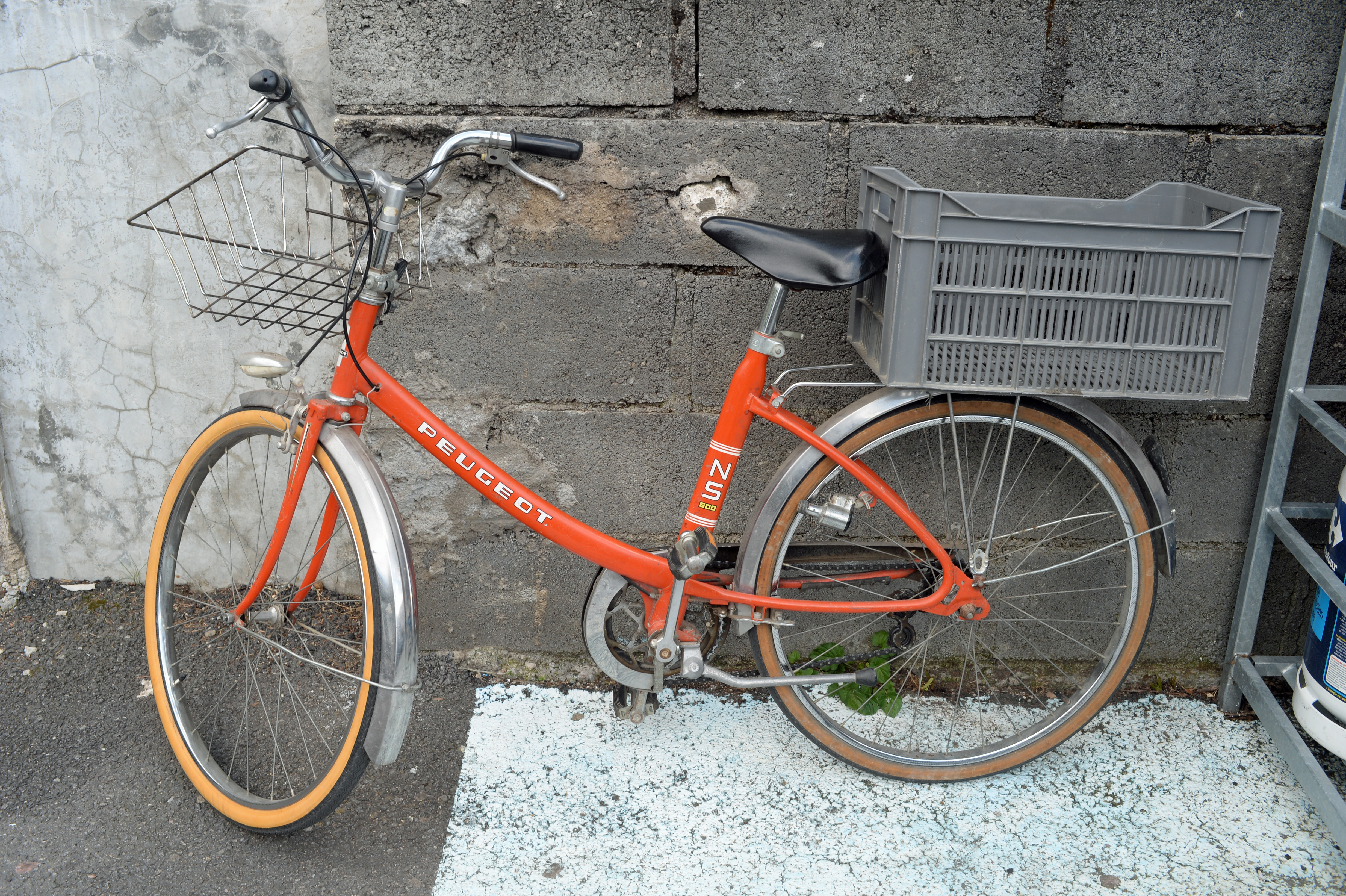
Peugeot folding bike evidence starts with a joint
The PNSA entry in the archived UK catalogue (https://www.bikeboompeugeot.com/Brochures%20UK/Peugeot%201980%20UK%20Brochure/Peugeot_1980_zUK_Catalog_PNSA_VX45_VX40_Page_5.jpg) explicitly describes a joint incorporated into the main frame for folding. Its storage claim belongs to that documented model. The page also lists guards, lighting and a carrier, making clear that compact transport and everyday equipment were considered together.
The archive labels this brochure 1980; the downloaded cover does not print a year. That label helps locate the document, but cannot date a bicycle advertised today. Ask which entry supports the seller’s model identification before using the catalogue’s equipment list as a checklist for that individual bicycle.
What the NS 600 photograph establishes
The orange bicycle pictured here is identified as a Peugeot NS 600. A central metal junction is visible, but this photograph does not establish its function or demonstrate folding. It is therefore neither proof of a folding NS 600 nor evidence that an NS 600 cannot fold. A mini and a folder are not mutually exclusive categories.
Ask for the missing storage information
Request photographs of the exact frame connection from both sides and, where folding is claimed, the bicycle in its folded state. Have the owner identify the operating parts using applicable instructions. A close-up of a knob alone leaves open whether it adjusts, clamps, separates or folds a particular assembly.
Then record the space you need to use: a hallway corner, car opening or cupboard. Ask for dimensions in the configuration actually being offered, including any basket or carrier. The NS 600 photograph shows a front basket and rear crate; neither is a verified original accessory or a proven removable part here.
Keep model proof separate from condition
A period document may explain a mechanism while saying nothing about wear on the machine in front of you. Arrange a competent inspection of unfamiliar joints and retention parts before relying on them. Explore the Peugeot topic collection for other ownership questions; the Peugeot brand introduction supplies the wider historical context.
FAQ
Does the NS 600 photograph prove that it folds?
No. Its identity and visible junction are documented, but folding operation remains unverified.
Can the PNSA specification be assigned to every small Peugeot?
No. The catalogue describes its named model, not every bicycle with a similar outline.
Does a mini bicycle have to be a non-folder?
No. Compact format and folding capability can coexist; confirm the particular mechanism rather than infer it from size.
Photograph credits and permissions
Photograph 1
Original title: Peugeot NS 600.jpg
Creator: Joost J. Bakker IJmuiden; creator URI: https://www.flickr.com/people/joostjbakkerijmuiden/; original source URI: https://www.flickr.com/photos/joostjbakkerijmuiden/51906720938/
Original source URI: https://commons.wikimedia.org/wiki/File:Peugeot_NS_600.jpg
License / permission: CC BY 2.0
License / permission URI: https://creativecommons.org/licenses/by/2.0/
Modification notice: The original image file is unchanged by this publisher. No previous modification notice supplied.
Source disclaimer: No warranties are given. No endorsement is implied. Other rights may apply.