


Peugeot Bike Identification: Read the Model Name Before the Badge
Peugeot bike identification begins with a modest question: what is actually written on this bicycle? A Peugeot badge establishes a brand claim, while model lettering can narrow the search. The purple machine pictured here clearly carries Tourmalet 14 lettering; calling it a PX10 because it has drop handlebars would discard that evidence.
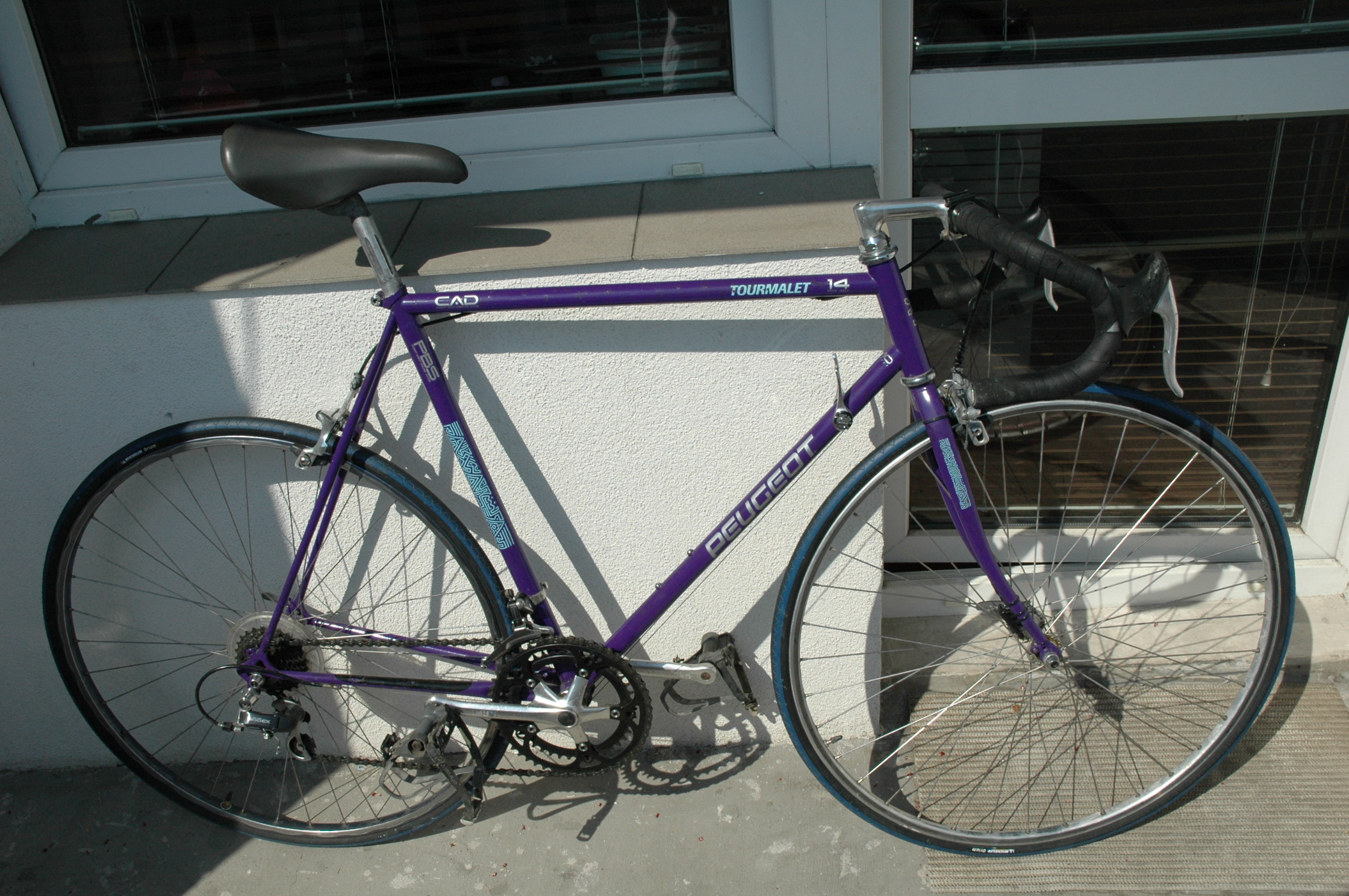
Build a Peugeot bike identification record
Photograph the complete bicycle before concentrating on a single decal. Add readable views of model text, the head badge, frame connections, controls and any serial marking. Record what is visible without assigning a year immediately. This produces an identification file that another reader can examine instead of an undocumented conclusion.
The photograph’s source names a Tourmalet 14, but this article has not authenticated its production year or original equipment. A photograph taken in 2006 establishes a capture record, not a manufacture date. Likewise, a component fitted today might help describe the present bicycle without proving what left the factory.
Compare named entries rather than appearances
The archived UK PKN and PX10 page (https://www.bikeboompeugeot.com/Brochures%20UK/Peugeot%201980%20UK%20Brochure/Peugeot_1980_UK_Catalog_PKN_PX10_Page_11.jpg) gives two distinct descriptions. Its Routier PKN lists twelve-speed gearing and narrow 700C wheels; its Professional PX10 lists Reynolds 531 and tubular tires. These details belong to those entries. They cannot be transferred to the Tourmalet merely because all three are Peugeot road bicycles.
Keep the catalogue’s market and date visible
The archive labels this UK brochure 1980, but the downloaded cover does not print a year. Preserve that qualification when citing it. A useful comparison needs the relevant market and document as well as the model name; a similar paint scheme is a clue to investigate, rather than a complete identity.
Work through disagreements explicitly. If model lettering points one way while a seller’s description points elsewhere, ask what supports the description. If equipment differs from a catalogue, record the difference before deciding whether the cause is a replacement, another edition or a mistaken identification. This source set does not resolve every such disagreement.
Stop where the evidence stops
No verified manufacturer serial-number decoder has been established here. A stamped number is worth preserving, but it should not become a precise year through an invented rule. Use the Peugeot introduction for brand context and the Peugeot collection to separate identification from later fit or maintenance decisions.
FAQ
Is every vintage Peugeot road bike a PX10?
No. The catalogue itself distinguishes named road models, and the photographed bicycle carries Tourmalet 14 lettering.
Does the photograph’s date identify the production year?
No. Capture date and bicycle manufacture date are different records.
Can this guide decode a Peugeot serial number?
No. It offers an evidence checklist, not an unsupported dating formula.
Photograph credits and permissions
Photograph 1
Original title: Bicycle Peugeot tourmalet.jpg
Creator: Peter.shaman at Polish Wikipedia; creator URI: https://pl.wikipedia.org/wiki/Wikipedysta:Peter.shaman
Original source URI: https://commons.wikimedia.org/wiki/File:Bicycle_Peugeot_tourmalet.jpg
License / permission: CC BY-SA 3.0
License / permission URI: https://creativecommons.org/licenses/by-sa/3.0/
Modification notice: The original image file is unchanged by this publisher. No further earlier modification notice supplied.
Source disclaimer: No warranties are given. No endorsement is implied. Other rights may apply.