


Nukeproof Mega Carbon Cleaning: Protect Inspection and Brake Surfaces
Nukeproof Mega Carbon cleaning should help reveal the bicycle’s condition as well as remove dirt. The 2023 MK4 care section recommends biodegradable cleaning products and says not to use a pressure washer. It also directs owners to lubricate the drivetrain afterwards, remove excess lubricant and avoid contaminating brake pads or rotors.
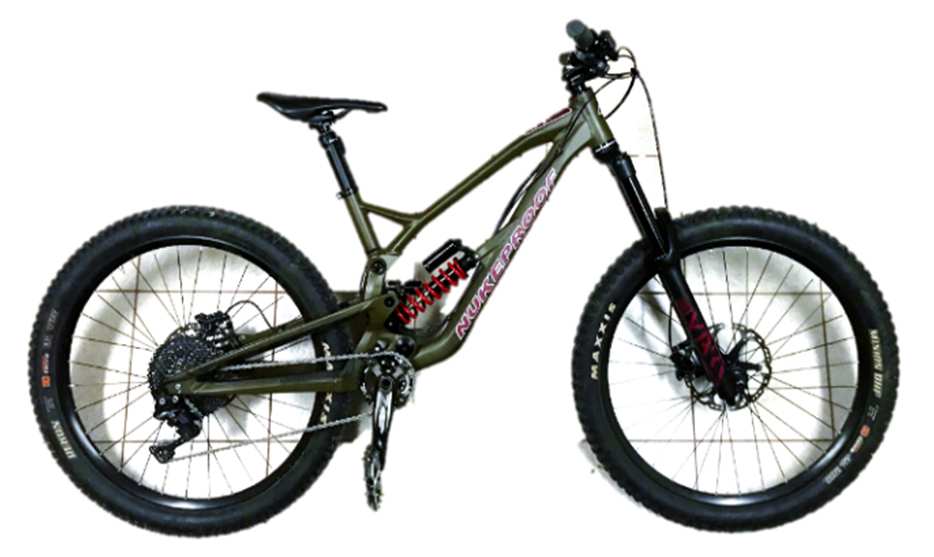
Nukeproof Mega Carbon cleaning: Follow the stated washing boundaries
Printed page 33 explains that pressurised washing can force water into components and wash grease from bearings or pivots. Do not convert that warning into an invented safe pressure setting or assume a stronger jet is acceptable from farther away. The manual gives no universal pressure-washer specification. Where cleaning-product compatibility is uncertain, check the requirements for the actual frame finish and components.
Dirt can also make visual inspection difficult, which is one reason the manual recommends regular cleaning. An accessible, clean surface is easier to examine than a mud-covered one, but appearance still has limits. A clean frame can have damage or worn parts. Treat cleaning as preparation for the relevant checks, rather than evidence that the bicycle’s condition has been confirmed.
Keep lubrication away from the braking system
The care instructions distinguish drivetrain lubrication from the brake surfaces that must remain uncontaminated. Plan where lubricant is applied and remove excess as directed. This guide does not suggest a chemical pad treatment, a rotor-restoration recipe or a way to certify contaminated brakes. If their condition or operation is uncertain, have the actual system assessed before riding.
The maintenance pages also ask for brake-pad and rotor-wear checks, wheel and bearing checks, and attention to the fitted components’ own instructions. A successful wash cannot replace those tasks. Nor should a new noise be dismissed because it appeared after cleaning: the manual directs owners to have unusual noises or creaks inspected rather than diagnose every sound as harmless.
Use the clean bicycle for a condition check
Page 31 says cracks or sharp dents in the frame or fork require dealer inspection and that the bicycle should not be ridden in that state. Page 33 explains that service life varies with factors including use, terrain, environment and maintenance. It gives no fixed number of years or washes that can guarantee a frame or bearing remains sound. Address an observed issue on its own evidence.
Find broader family coverage in the Nukeproof topic and Nukeproof introduction. For ongoing care, pair the bicycle guidance with the actual suspension, brake and other component instructions. Keep any inspection findings and completed service information with the bike. A routine clean is most useful when it supports those decisions without disguising a repair need or creating brake contamination.
FAQ
Does the manual provide a safe pressure-washer setting?
No. It says not to use a pressure washer because of water ingress and grease loss.
Where should excess drivetrain lubricant be kept away from?
The manual specifically warns against contaminating brake pads and rotors.
Does a clean appearance establish that a damaged frame can be ridden?
No. Cracks or sharp dents require inspection, and the manual says not to ride in that state.
Sources
The MK4 care section rejects pressure washing, asks owners to keep lubricant off braking surfaces and links cleaning with inspection rather than a fixed component lifespan. Printed pages 31, 32, 33 of the 2023 Mega MK4 Carbon manual (https://cdn.shopify.com/s/files/1/0438/3296/7322/files/MY23_-_NP_-_Editorial_-_Mega_Carbon_Bike_Manual.pdf?v=1687182192), retrieved 28 October 2026, support this model-specific explanation.
Photograph credits and permissions
Photograph 1
Original title: Figure 25(b), complete bike assembly, in Analysis of Symmetrical/Asymmetrical Loading Influence of the Full-Suspension Downhill Bicycle’s Frame on the Crack Failure Formation at a Critical Point during Different Driving Scenarios and Design Improvement
Creator: Vladimír Bulej, Ivan Kuric, Milan Sága, Milan Vaško, Zuzana Ságová, Michal Bartoš and Stanislaw Legutko; individual photographer not specified
Copyright notice: © 2022 by the authors. Licensee MDPI, Basel, Switzerland.
Original source URI: https://mdpi-res.com/d_attachment/symmetry/symmetry-14-00255/article_deploy/symmetry-14-00255.pdf
License / permission: CC BY 4.0 International
License / permission URI: https://creativecommons.org/licenses/by/4.0/
Modification notice: Selected photo panel(b): JPEG object687 extracted without re-encoding from the source PDF. The separately downloaded source PNG contains panels(a)+(b); it is not the delivered JPEG. No visual edits applied.