


Kona Dew Deluxe gearing: distinguish the 2016 triple from the 2021 single
Kona Dew Deluxe gearing changed substantially between the two official archive entries considered here. A used-bike description that simply says Dew Deluxe therefore leaves a major question unanswered. The 2016 reference uses three chainrings, while the 2021 reference uses one. Identify the relevant build before counting gears or comparing the lowest available ratio.
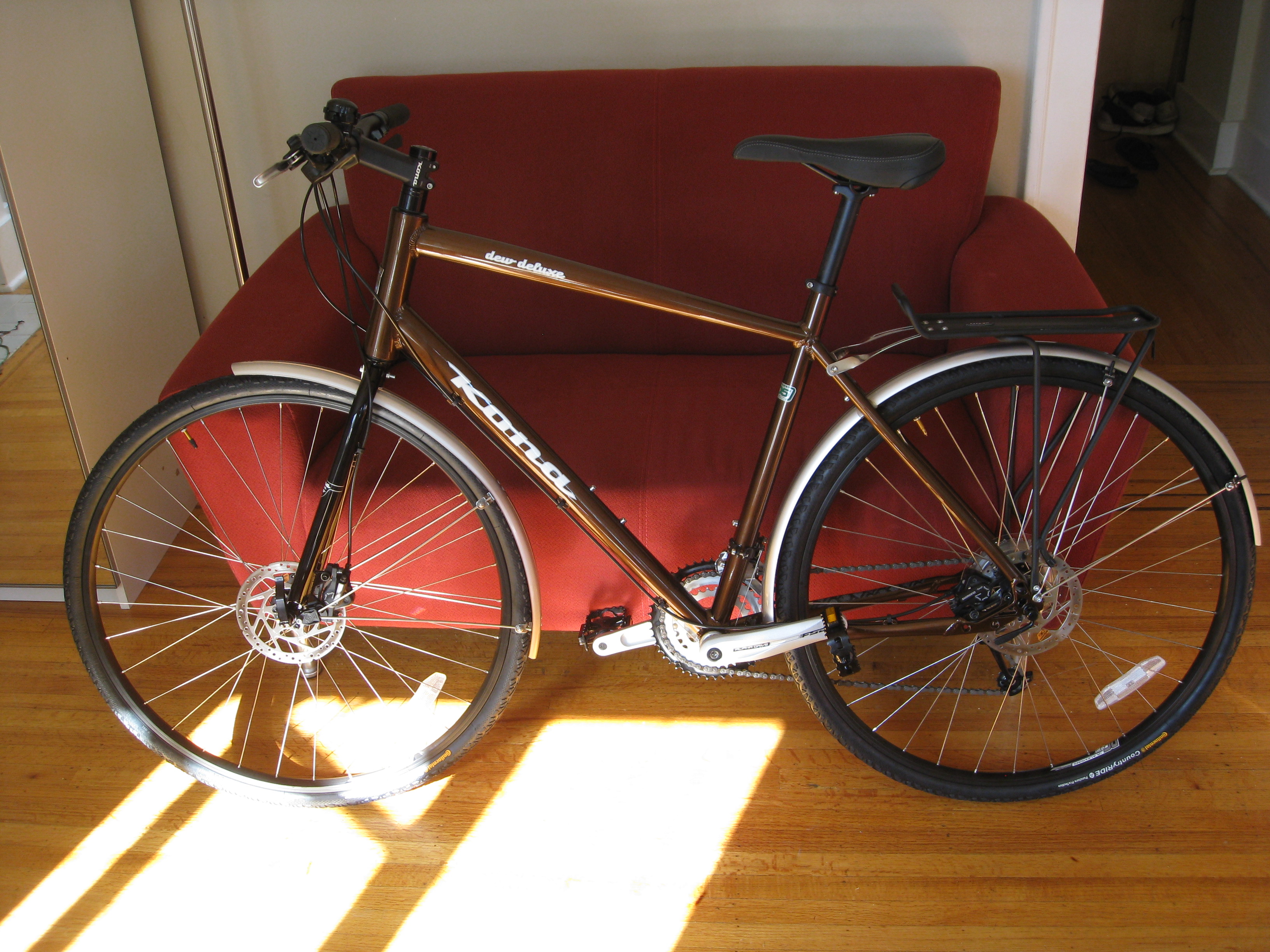
Read Kona Dew Deluxe gearing from separate component rows
For 2016, Kona lists Shimano Alivio crankarms with 26, 36 and 48-tooth chainrings, an Alivio eleven-to-thirty-four-tooth nine-speed cassette, an Acera front derailleur and an Alivio rear derailleur. The shifters are Acera and the chain is KMC Z99. This is a mixed inventory, so one visible Alivio marking cannot identify the whole drivetrain.
The 2021 specification instead names Samox crankarms with a single 38-tooth chainring, a Shimano Deore eleven-to-fifty-one-tooth eleven-speed cassette, and Deore rear derailleur and shifters. Its front-derailleur row says not applicable. Those rows describe a different control arrangement as well as a different cassette.
Compare endpoints rather than advertised gear counts
Dividing chainring teeth by rear-sprocket teeth gives a simple dimensionless ratio. The 2016 low endpoint is 26/34, approximately 0.76; its high endpoint is 48/11, approximately 4.36. For 2021 the corresponding calculations are 38/51, approximately 0.75, and 38/11, approximately 3.45. These are calculations from the published teeth, not measured riding results.
The lower endpoints are close on that basis, despite the different number of chainrings. The high endpoints differ more. Neither comparison establishes distance travelled per pedal revolution, because the archived wheel and tyre specifications also changed. Nor does it measure efficiency, wear, shifting quality or how a particular rider will manage a gradient.
Another useful calculation is the high-to-low ratio span: approximately 5.71 for the triple and 4.64 for the single-ring build. Calculate from the original teeth before rounding; dividing rounded endpoints can produce a slightly different result. That describes the overall interval between endpoints, not the gaps between adjacent gears. The cassette range alone does not supply its complete sprocket sequence, so this comparison cannot promise that every shift feels equally close.
Identify the fitted system before discussing replacements
Ask for readable markings on the crank, cassette, controls and both derailleur positions. Record the actual number of rear sprockets and any documented replacements. A seller may correctly name the frame while offering equipment that differs from its original build. Keep that observation separate from a judgement about installation or condition.
Use this Kona Dew Deluxe gearing comparison to label what is documented and what is fitted. It does not approve an eleven-speed conversion, a different freehub or a replacement derailleur. A workshop needs the complete installed system to assess those questions. The accompanying older photograph shows the named model family; it does not verify either archived drivetrain.
FAQ
Was every Dew Deluxe supplied with one chainring?
No. The selected 2016 archive explicitly specifies three chainrings; the selected 2021 entry specifies one.
Does eleven-speed automatically mean a lower climbing ratio?
No. Compare the actual chainring and largest sprocket teeth; gear count alone does not determine the endpoint.
Does the calculated span describe the gaps between consecutive gears?
No. It compares the highest and lowest tooth ratios. The selected range entries do not give a complete step-by-step sprocket sequence.
To extend the ratio comparison, consult the Dew Deluxe wheel and tyre generation guide; other brand references sit in the Kona topic.
Sources: Kona 2016 Dew Deluxe official archive; Kona 2021 Dew Deluxe official archive.