


KHS Folding Bike Weight: Compare the Carried Setup, Not Just the Catalog
A KHS folding bike weight figure is useful only when you know which bicycle and equipment it describes. The English F20-R page gives a reference of 10.4 kg, the original-language F20-JJ page lists 12.02 kg, and the ePony specification states 18 kg including its battery. These are starting references, rather than matched carrying tests.
Read each KHS folding bike weight in context
The F20-JJ page explicitly says actual weight varies with frame size and accessories. The F20-R and ePony pages describe different constructions and equipment. Only the ePony figure in this comparison explicitly identifies battery inclusion, so the three numbers should not become a precise ranking of otherwise identical packages.
The P20-T451 adds another useful distinction. Its listed reference is 10.68 kg, but the manufacturer describes a rigid, nonfolding mini velo. A small wheel and a modest published mass do not establish that the frame folds. Check the construction before treating it as a substitute for a folder carried into a building.
Account for the bicycle you will actually lift
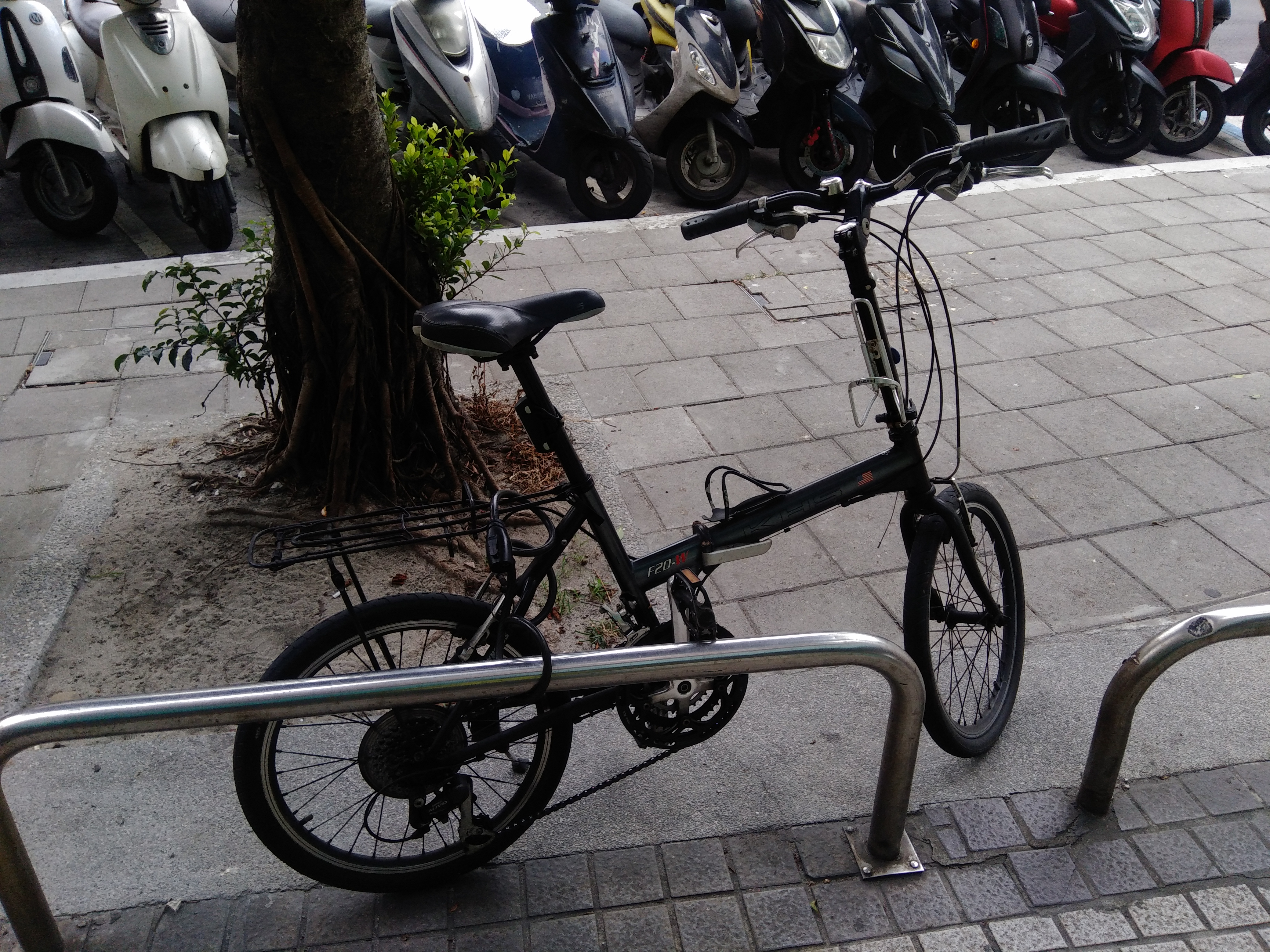
The historical F20-W photograph shows a rear rack and other fitted equipment. No weight measurement accompanies that photograph. Its value here is the visible difference between a complete, equipped bicycle and an isolated number in another model’s specification.
Write down what will remain attached during the transfer: bags, locks, lights and any other accessories fitted to the actual machine. Ask the seller to demonstrate the intended carried arrangement and clarify which items were included in a quoted weight. A comparison becomes meaningful when the equipment and handling task are described together.
Plan the awkward part of the transfer
Consider where the bicycle has to be lifted, where you can set it down and how much space is available around you. A short lift into storage differs from carrying the same package through a station. The manufacturer figures do not measure your individual ability to manage either task.
Obtain the matching folding and handling instructions for the exact bicycle. This guide supplies no clamp operation or lifting technique for an unidentified assembly, and a folder is not automatically accepted by every transport operator. Explore the KHS folding-bike reading alongside the brand overview, then compare a demonstrated setup with the journey you actually make.
FAQ
Is the photographed F20-W the 10.4 kg model?
No. That figure belongs to the documented F20-R; the older photograph has no measured weight.
Does the ePony reference include its battery?
Yes. Its specification explicitly labels the 18 kg figure as including the battery.
Is the 10.68 kg P20-T451 another folding frame?
No. Its manufacturer description identifies a rigid, nonfolding mini velo despite its compact wheels.
Official reference 1 (https://en.khsbicycles.com.tw/products/f20-r-mini-folding-bike/).
Official reference 2 (https://www.khsbicycles.com.tw/products/folding-bikes/f20-jj/).
Official reference 3 (https://en.khsbicycles.com.tw/products/epony-foldable-ebike/).
Official reference 4 (https://en.khsbicycles.com.tw/products/p20-t451-mini-velo/).
Photograph credits and permissions
Photograph 1
Original title: 一台Khs折疊車.jpg
Creator: Zsfi; source-provided creator URI: https://commons.wikimedia.org/wiki/User:Zsfi
Original source URI: https://commons.wikimedia.org/wiki/File:%E4%B8%80%E5%8F%B0Khs%E6%8A%98%E7%96%8A%E8%BB%8A.jpg
License / permission: CC BY-SA 4.0
License / permission URI: https://creativecommons.org/licenses/by-sa/4.0/
Modification notice: Original Commons JPEG retained unchanged by this publisher; no crop, resize, conversion, retouching, re-encoding or metadata removal. Prior source edits unassessed. Photograph remains under CC BY-SA 4.0.
Source disclaimer: No endorsement by the photographer is implied. Historical F20-W photographed on 15 April 2021; it is not a current F20R, F20-JJ or P20-T451 photograph.