


Electra Flat Foot Technology: What the Geometry Helps You Check
Electra Flat Foot Technology changes the relationship between the saddle and pedals. Understanding that relationship is more useful than treating the name as a promise that every Electra will fit every rider. Start with two separate questions: can you reach the ground comfortably when stopped, and can you pedal comfortably when moving?
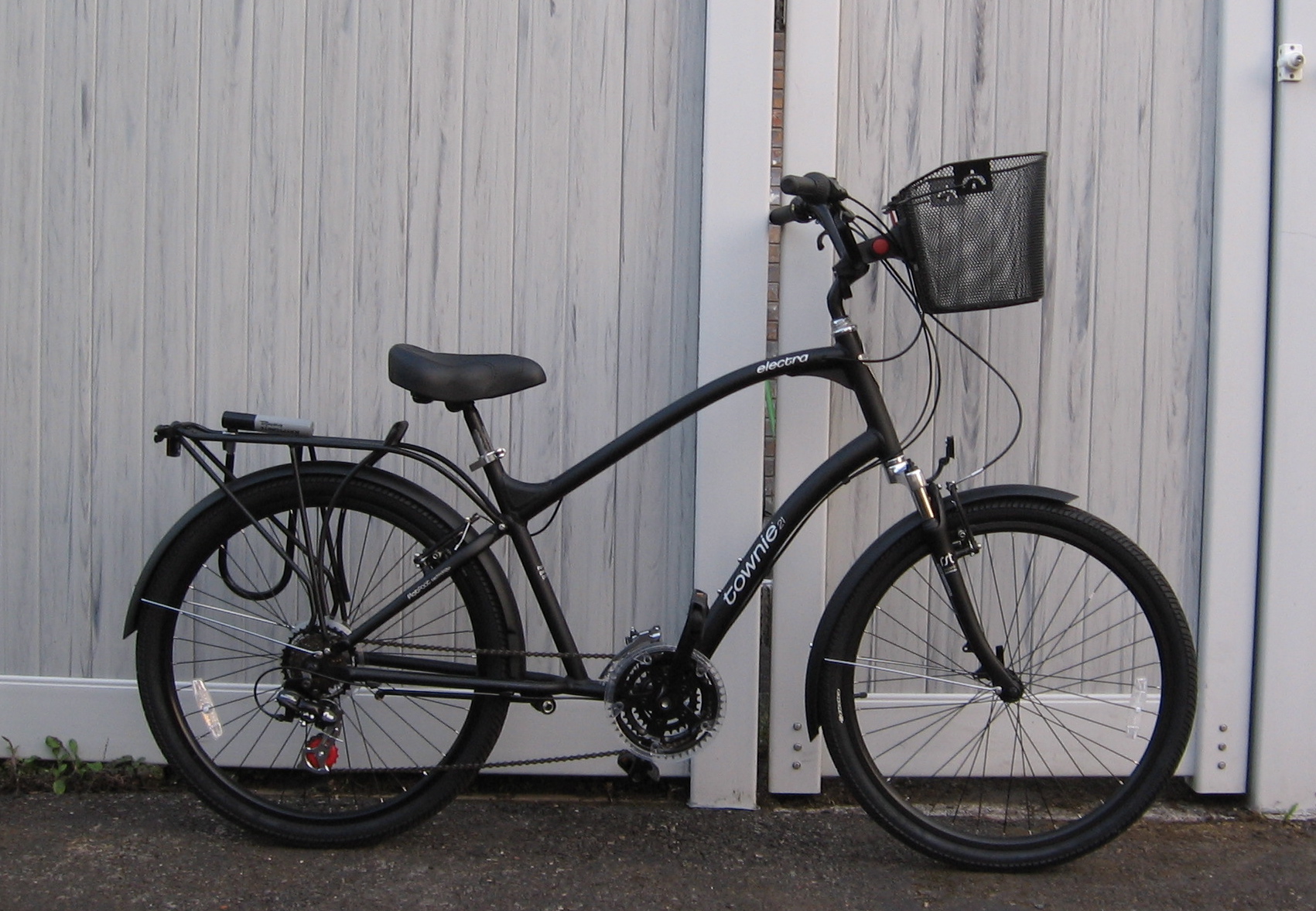
Electra Flat Foot Technology: Look at the arrangement, rather than lowering any saddle
Electra's April 2026 owner's manual discusses Flat Foot Technology in its first-ride fit section. The relevant idea concerns the complete bicycle's geometry. Simply lowering the saddle on a different frame does not reproduce that geometry, and a photograph cannot establish your leg extension or control reach.
The historical Townie 21 shown here provides a concrete Electra example. Its original photographer identifies the model, while its fitted basket, rack and mudguards belong to the photographed bicycle. These details should not be read as a specification for a current Townie or a list of accessories included with another model.
Separate the stopped position from the pedalling position
Ask a shop to help you compare both positions on the bicycle you are considering. Explain whether your difficulty is reaching the ground, reaching the handlebars or moving comfortably through the pedal stroke. These are different observations, even when a rider describes all three as needing a lower bike.
Turn the idea into a useful fit discussion
Take the shoes you expect to wear and identify the exact frame version. With the bicycle supported appropriately, discuss ground reach and access to the brake controls. Then have the shop assess the pedalling position. A successful check should connect those observations rather than improve one by creating another problem.
The manual identifies a minimum insertion mark on the seatpost. That mark constrains an adjustment; it is not a suggestion to pull the post farther out when a frame feels too small. If you cannot obtain the appropriate position within the permitted adjustment, ask about another bicycle or an approved component assessment.
Keep a note of the model and setup that worked. A description such as upright or comfortable does not record the actual setting. The Electra topic provides range context, while the existing brand introduction explains how this geometry fits Electra's broader design approach.
Keep expectations specific to the person riding
This geometry is not evidence of a medical benefit, a balance guarantee or suitability for a particular age. No riding trial is reported here. The practical result is a clearer fit conversation: identify the bicycle, check both stopped and pedalling positions, and keep the controls within comfortable reach.
FAQ
Does Flat Foot Technology mean every Electra fits everyone?
No. Fit still depends on the particular bicycle and rider; the manual recommends help from a shop.
Can I copy the idea by lowering another bike's saddle?
Lowering a saddle alone does not reproduce Electra's complete frame geometry.
What does the historical Townie photograph prove?
It records that photographed Townie 21, not another model's equipment or a rider's personal fit.
Sources
The April 2026 Electra Owner’s Manual, printed page 8, describes Flat Foot frame geometry and the rider-specific fit check. Its illustration explains a design principle; the Townie photograph does not establish a later model’s fit. Documents checked 26 October 2026: Electra Owner’s Manual, April 2026 (https://media.trekbikes.com/image/upload/v1777059479/ELectra_OwnersManual_April2026.pdf).
Photograph credits and permissions
Photograph 1
Original title: Electra Townie 1
Creator: Chris Harley
Original source URI: https://www.flickr.com/photos/chrisharley/218863368/
License / permission: CC BY-SA 2.0 Generic
License / permission URI: https://creativecommons.org/licenses/by-sa/2.0/
Modification notice: Original downloaded JPEG unchanged; no crop, colour change, re-encoding or metadata removal.