


Boardman SLR 8.9 Di2 Gearing: What the 34-by-34 Lowest Gear Means
Boardman SLR 8.9 Di2 gearing illustrates why a 12-speed drivetrain and a low climbing gear describe different things. On Boardman’s SLR 8.9 Disc Di2 catalogue entry 2398, the smallest chainring and largest rear sprocket both have 34 teeth. That produces a one-to-one lowest ratio. Understanding the arithmetic is more useful than assuming the extra sprocket alone makes the bike easier uphill.
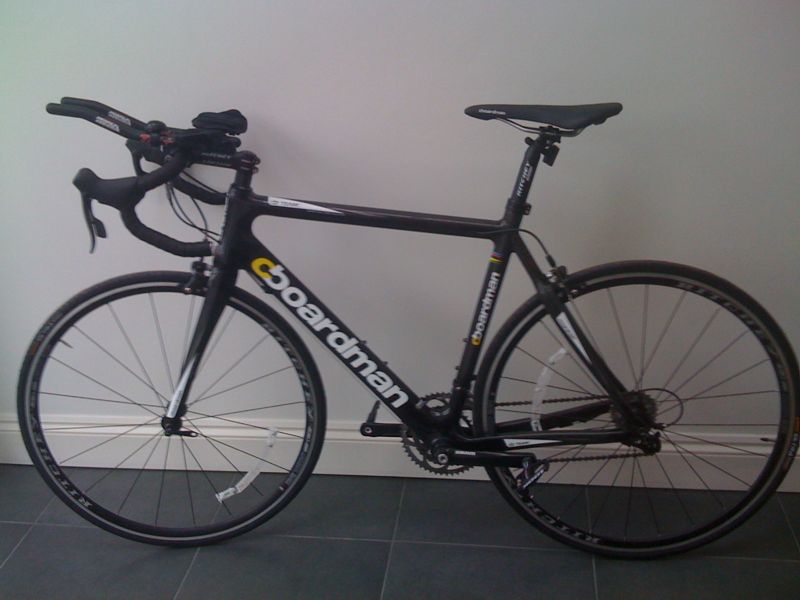
Boardman SLR 8.9 Di2 gearing in numbers
The inspected Di2 listing specifies a 50/34 chainset and an 11–34 cassette. For comparison, the mechanical SLR 8.9 Disc entry 2369 specifies 50/34 with 11–30. These are two particular catalogue configurations, not a specification for every bike advertised simply as “SLR 8.9”.
| Listed configuration | Lowest combination | Front teeth ÷ rear teeth |
|---|---|---|
| 2398 Disc Di2 | 34 × 34 | 1.00 |
| 2369 mechanical Disc | 34 × 30 | Approximately 1.13 |
The calculation compares the lowest available ratios. With the same effective wheel size, the lower ratio moves the bicycle a shorter distance for each crank revolution. This gives a meaningful way to compare gearing without inventing a climbing speed or a power requirement.
Separate range from the number of steps
The Di2 listing has twelve rear sprockets; the inspected mechanical listing has eleven. Counting sprockets tells you how many rear choices there are, but you still need their tooth counts to establish the lowest gear. More sprockets do not automatically mean a larger largest sprocket.
Think about two separate questions when comparing bicycles. Is the lowest ratio appropriate for the kind of climbs you ride? Are the intermediate choices useful for keeping a comfortable pedalling rhythm? The first question needs the extremes in the table. The second needs the complete cassette specification and your own riding preferences.
The Boardman road-family background is a starting point for understanding where the SLR sits. This numerical comparison then narrows the question to specific builds rather than the whole road range.
Use the comparison without turning it into an upgrade recipe
Someone considering an existing bicycle should read the markings on its fitted chainrings and cassette. Those may differ from the original catalogue after servicing or an upgrade. Recalculate from the actual tooth counts if necessary, and keep wheel size consistent when comparing distance travelled per pedal revolution.
The table is not approval to put an 11–34 cassette on another drivetrain. Rear-derailleur limits, chain requirements and the rest of the equipment need their own manufacturer checks. Electronic shifting is also not a promise that every component transfers to an older mechanical setup.
Use the Boardman model references to locate the right catalogue context, then separate a complete-bike comparison from any proposed parts change. A lower published ratio is a measurable difference; how comfortably you climb also depends on the rider, route and bicycle setup.
FAQ
What does a 34-by-34 lowest gear mean?
The front and rear tooth counts are equal, giving a ratio of one. It is a drivetrain ratio, not a fixed speed for a climb.
Does twelve-speed always mean lower gearing than eleven-speed?
No. The smallest chainring and largest sprocket determine the lowest ratio. The number of rear sprockets is a separate specification.
Can I reproduce this gearing with a cassette swap?
Not from this comparison alone. Have the complete proposed combination checked against its component manufacturers’ compatibility requirements.
Primary references: manufacturer reference 1 (https://www.boardmanbikes.com/gb_en/products/2398-slr-8.9-di2-disc-carbon.html); manufacturer reference 2 (https://www.boardmanbikes.com/gb_en/products/2369-slr-8.9-carbon-disc-2021.html).
Photograph credits and permissions
Photograph 1
Original title: My Boardman Bike
Creator: Peter C; creator URI: https://www.flickr.com/photos/pmcowley
Original source URI: https://www.flickr.com/photos/pmcowley/3306171226/
License / permission: CC BY 2.0
License / permission URI: https://creativecommons.org/licenses/by/2.0/
Modification notice: Original JPEG bytes unchanged.